Google Promotes Gemini 4 Hydrogen Model To Users
Google is inviting users to try its new Gemini 4 Hydrogen model with a popup on its Search homepage, according to Search Engine Watch. This promotion aims to showcase the model's capabilities.
Original reporting · searchenginewatch.com
Original: “Google wants you to try Gemini 4 Hydrogen with ‘Search just got an upgrade’ popup”
Read “Google wants you to try Gemini 4 Hydrogen with ‘Search just got an upgrade’ popup” at Search Engine Watch →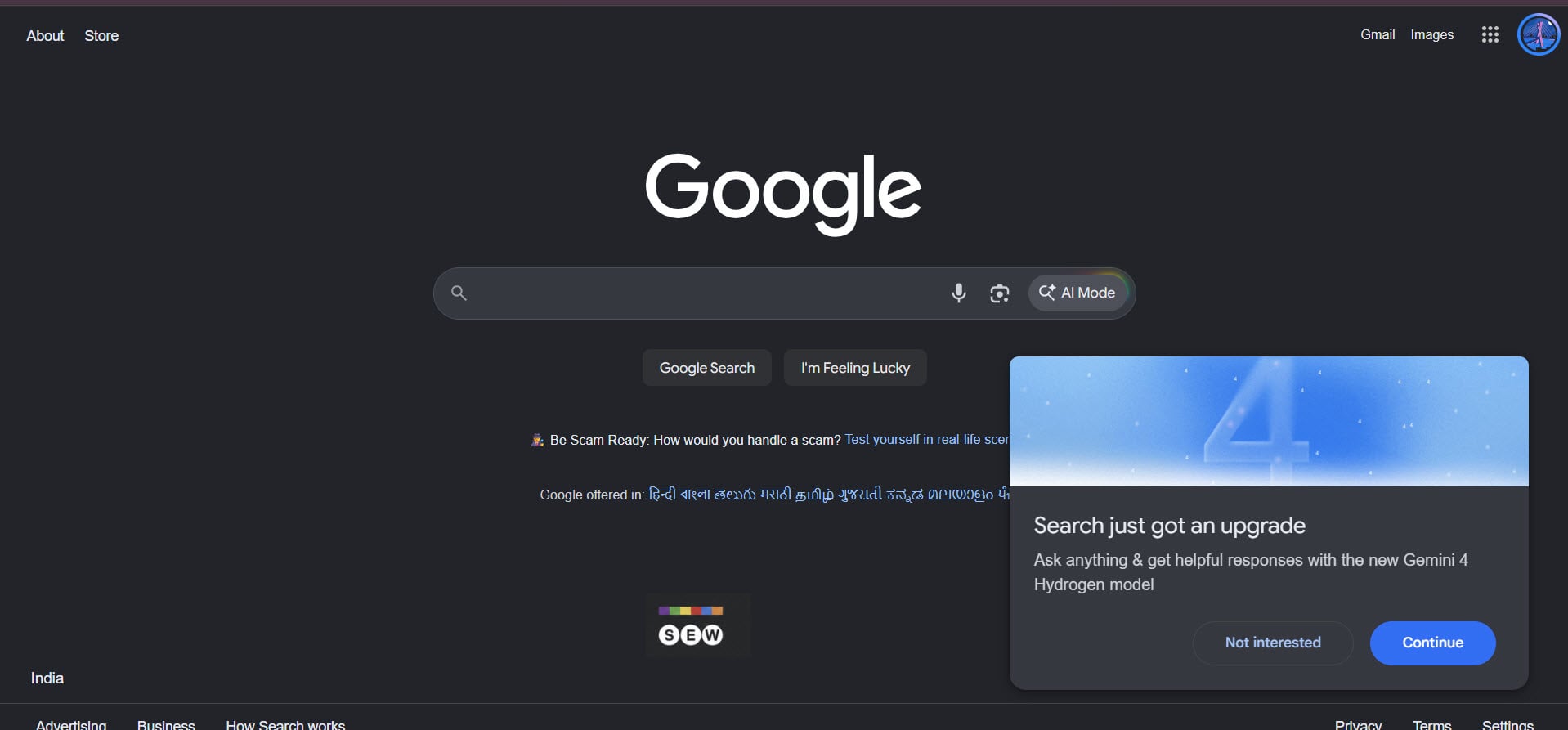
How this was written. Clicktag wrote this article with a language model from Search Engine Watch’s reporting (model: @cf/meta/llama-3.3-70b-instruct-fp8-fast); it describes that reporting rather than adding to it. The original, linked above, is the full story.
Key points from Search Engine Watch’s report
- Google is promoting its new Gemini 4 Hydrogen model through a popup on its Search homepage.
- The model is designed to improve Google's understanding of complex queries and provide more relevant search results.
- The promotion follows the global rollout of the Gemini 4 Hydrogen model in Search.
- The model's capabilities include running multiple searches across related subtopics to find more relevant information.
- The visibility of the popup may vary depending on the user's account status and other factors.
Google is showcasing its new Gemini 4 Hydrogen model to users through a promotional popup on its Search homepage. The popup is an effort to encourage users to try out the new model. Search Engine Watch reported that the popup appears in the lower-right corner of the desktop homepage.
The popup features a headline stating that search has been upgraded and offers users the option to try the new model. It provides two buttons for users to respond, allowing them to either continue or express disinterest. By clicking continue, users can experience the capabilities of the Gemini 4 Hydrogen model.
When a user clicks the continue button, Google opens a new tab with a prefilled query related to the Gemini 4 Hydrogen model. This allows users to quickly understand the model's features without having to type a question. The response is generated by Google's AI Mode, providing a simple explanation of the model's capabilities.
The promotion of the Gemini 4 Hydrogen model follows its global rollout in Search, which was announced on November 12. The model is designed to improve Google's understanding of complex queries and provide users with more relevant search results. This upgrade aims to enhance the overall search experience for users.
The Gemini 4 Hydrogen model is expected to improve search results by running multiple searches across related subtopics. This feature enables users to find more relevant information and discover new websites. The model's capabilities are being showcased through the promotional popup, allowing users to experience its features firsthand.
It is unclear how widely the popup is being displayed or whether all users can see the promotion. The visibility of the popup may vary depending on the user's account status and other factors. Search Engine Watch noted that the popup's appearance may differ for signed-in and signed-out users.
The promotion of the Gemini 4 Hydrogen model is part of Google's efforts to enhance its search capabilities and provide users with more accurate and relevant results. The company continues to develop and improve its models to meet the evolving needs of its users. The Gemini 4 Hydrogen model is a significant upgrade to Google's search capabilities, and its promotion aims to increase user awareness and adoption.
Questions and answers
What is the Gemini 4 Hydrogen model?
The Gemini 4 Hydrogen model is a new search model designed to improve Google's understanding of complex queries and provide more relevant search results.
How can users try the Gemini 4 Hydrogen model?
Users can try the Gemini 4 Hydrogen model by clicking the continue button on the promotional popup on Google's Search homepage.
What are the benefits of the Gemini 4 Hydrogen model?
The Gemini 4 Hydrogen model provides more relevant search results by running multiple searches across related subtopics, enabling users to find more relevant information and discover new websites.